Why I Track Everything (And What I Actually Do With It)
I've lost 70 pounds before. I've also gained it all back. This time I'm building something that won't let me pretend it's not happening.

Six or seven years ago, I lost 70 pounds. The tracking was minimal by today's standards: the odd Strava PR, my FTP (the maximum watts you can sustain for an hour – cyclists obsess over it), and my weight. That was it. No recovery scores, no sleep stages, no strain metrics. Just a few numbers I cared about and a lot of time on the bike.
FTP – Functional Threshold Power: the maximum watts you can sustain for an hour. Cyclists obsess over it.
It worked. I could see the cause and effect clearly. Ride more, eat less, watch the weight drop and the FTP climb. Simple. It helped that I had far more time on my hands back then. Hours on the bike every week weren't something I had to fight for.
Fast forward to today, and the landscape has exploded. I now have access to WHOOP for recovery and strain, TrainerRoad for structured training, Strava for activities, and various nutrition apps competing for my attention. More data than I ever dreamed of having.
And yet, somehow, it's harder to see the full picture than it was with a spreadsheet.
The Integration Problem
Here's what actually happens with modern fitness apps: some of them talk to each other, sort of. TrainerRoad pushes workouts to Strava. Strava syncs with WHOOP. WHOOP knows when I've trained.
But nutrition? That sits in its own silo.
If I want my food data to inform my training recommendations, or my recovery scores to influence my calorie targets, I'm looking at expensive premium tiers across multiple apps, complicated Zapier workflows, or just... doing it manually in my head.
The irony isn't lost on me. We have more fitness data available than ever before, spread across more apps than ever before, and yet getting a unified view requires either significant money or significant effort.
What I Actually Want
In my first post, I mentioned Grant Ritchie's video about using AI as a fitness coach. The idea stuck with me: what if I could have something that looks at all my data together and gives me actual, personalised advice? Not generic "eat more protein" suggestions, but recommendations based on what I actually did yesterday, how I actually slept, and what I'm actually trying to achieve.
That's the real goal here. Not just dashboards. Not just pretty graphs. I want to ask questions like:
Given my recovery score and yesterday's training, what should I eat today?
My weight has plateaued but my strain is high. What's going on?
I have a big ride planned for Saturday. How should I fuel this week?
No single app on the market can answer these questions, because no single app has all the data.
So I Built Something
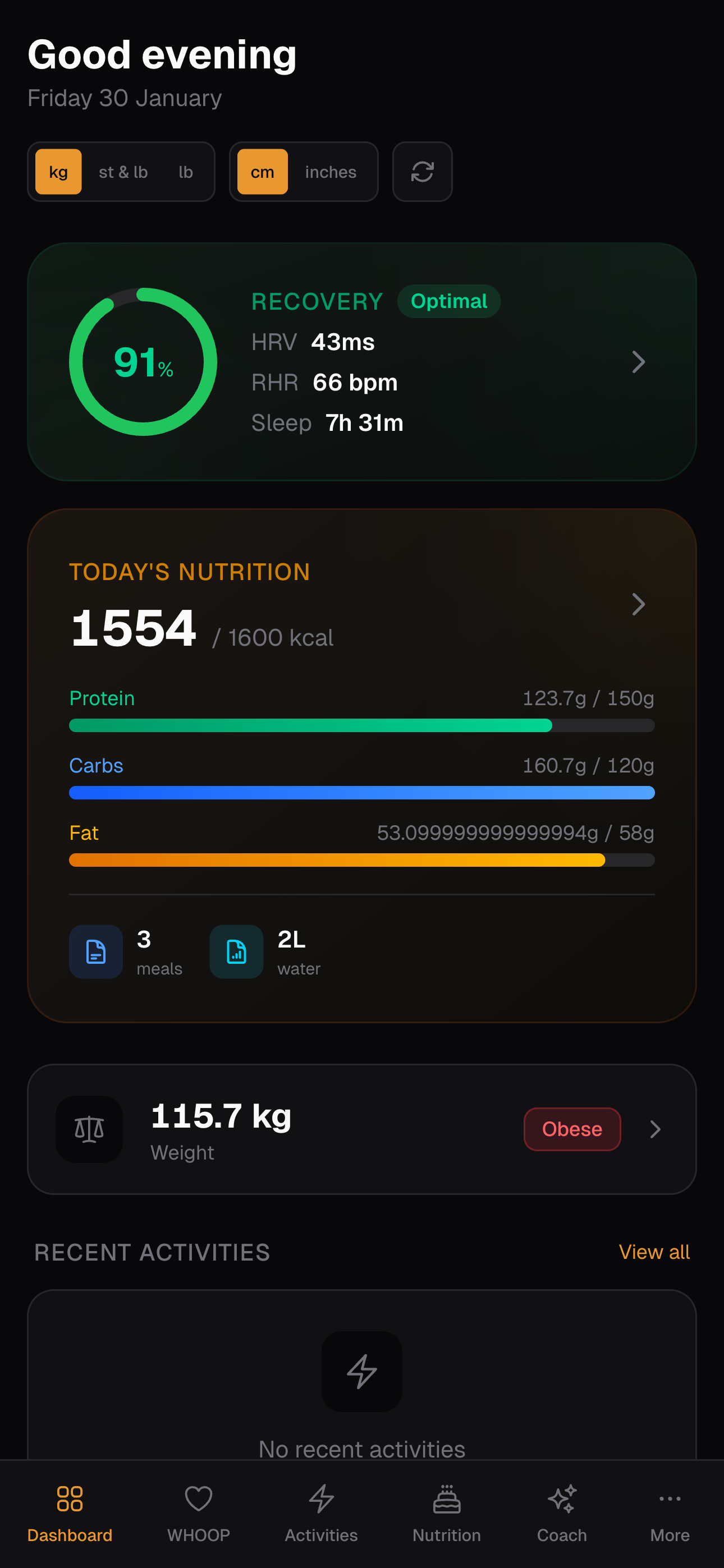
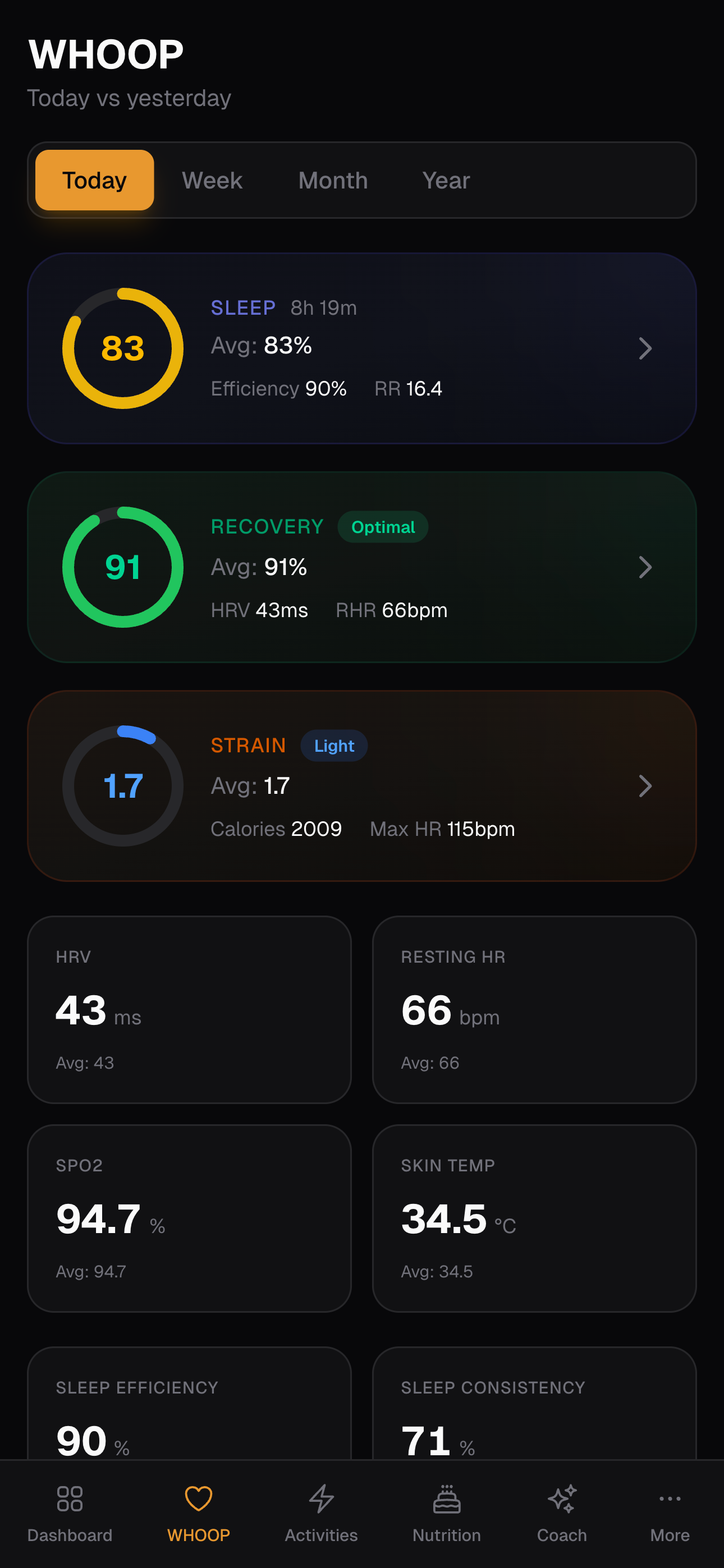
This is my portal. Everything in one place. WHOOP data syncs automatically. Strava activities pull in overnight. I log my weight and nutrition manually because, honestly, that's the only way to get it all in one system without paying for three different premium subscriptions that still won't talk to each other properly.
The dashboard shows me what actually matters:
How I slept last night
What my recovery looks like
Whether I've actually been training or just thinking about training
What I've eaten and how it compares to my targets
My weight trend over time
What The Data Actually Tells Me
Here's the honest bit: I haven't started training yet. The app is built, the integrations are working, but so far all I've done is take Mounjaro, eat better, and watch the weight come down.
And that's fine. The weight loss is working. The trend is heading the right direction. But I know that losing weight and being fit enough to cycle 6 miles each way to work are different things. The diet that's working for weight loss will need tweaking when I start burning 500+ calories on a commute.
So rather than waiting until I'm fit, I've started planning what preparation actually looks like.
The AI Piece
This is where it gets interesting. I've been using Claude not just to build the app, but to plan the journey back to fitness.
My commute isn't flat. There are hills. And I know from experience that the first few weeks of cycling after a long break are brutal. So I've been having conversations like:
"Given my current weight and zero cycling fitness, what does a realistic 8-week plan to commute-ready look like?"
"The commute has a 50m elevation gain in the first 2 miles. How do I prepare for that specifically?"
"I'm losing weight on 1800 calories. When I start training, how do I adjust without stalling the weight loss?"
Food prep is another example. I've told it my likes, dislikes, and what I can realistically cook on a weeknight. It gives me meal suggestions for the week with portion sizes, and explains how certain foods might affect my sleep or next day's training. Not a generic meal plan from a website - one that accounts for the fact I hate cottage cheese and have to pick Megan up from work at 8pm Tuesday to Friday, so those dinners need to be quick.
I've also learned to be honest with it. When I knew I had a stag do coming up, I didn't pretend it wasn't happening. I asked: "I'm going on a stag do this weekend. What's that going to do to my recovery? How do I get back on track afterwards?" The answer was practical, not preachy. That matters.
The answers aren't generic. They're based on my actual situation: my weight, my schedule, my route, my goals. That's the difference between watching a YouTube video about "how to get fit for cycling" and having a conversation about my cycling, with my constraints.
The dashboard shows me where I am. The AI helps me figure out where to go next. That's the combination I'm building towards.
The Output
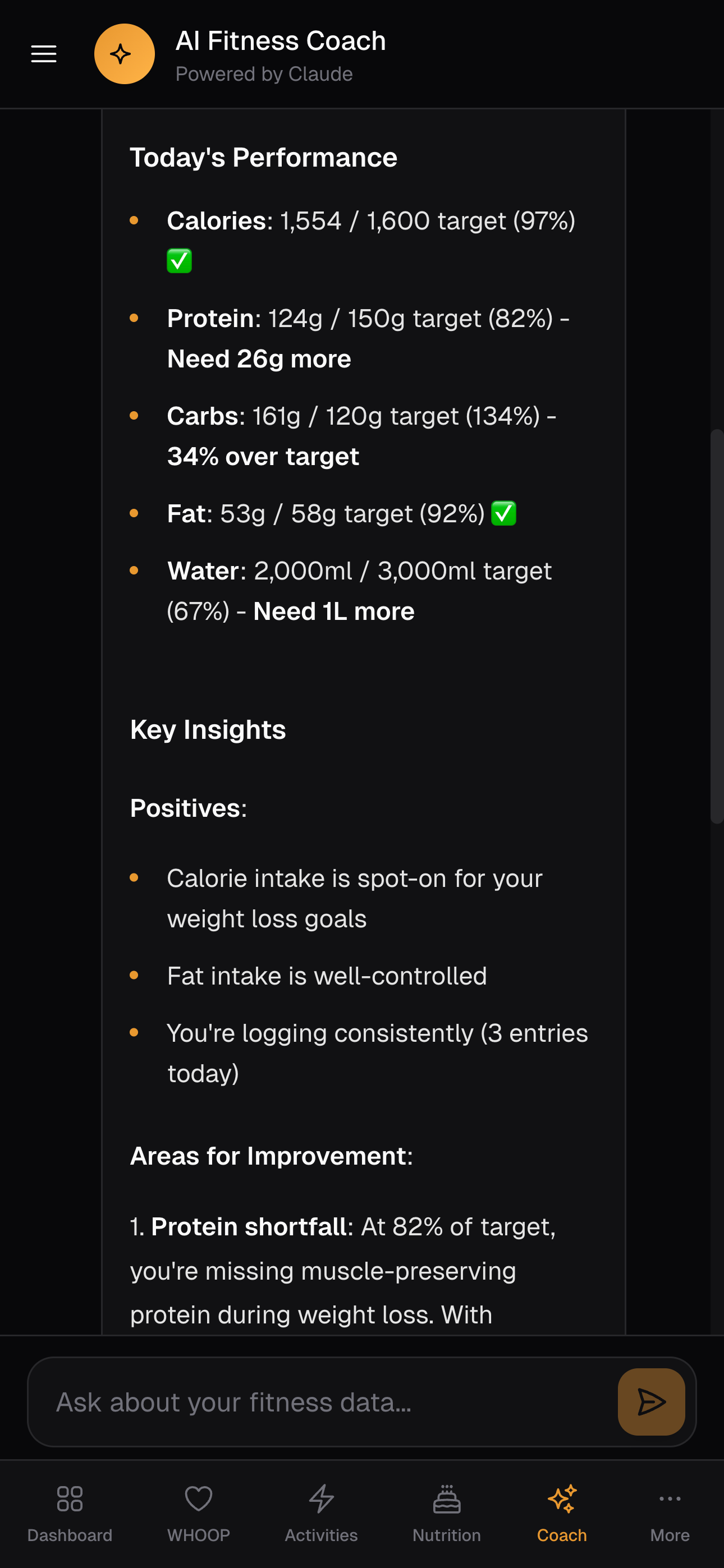
Here's an actual example. I asked Claude to help me plan the 8 weeks before I start commuting, given my current fitness (none) and the fact that my route has a decent hill in the first two miles. This is a summary of what it gave me:
Weeks 1-2: Foundation
3x 20-minute easy indoor rides. No intensity, just turning the pedals. The goal is getting your legs used to the motion again and building the habit.Weeks 3-4: Build Duration
3x 30-minute rides, adding one short hill effort per session (2 minutes at a pace where talking is difficult). Start introducing the gradient your legs will face on the commute.Weeks 5-6: Simulate the Commute
2x 40-minute sessions including 5-minute sustained efforts. One weekend ride outdoors if weather permits - ideally on or near your actual route.Weeks 7-8: Rehearsal
Do the actual commute on a weekend. Both directions. Note where it hurts. Adjust.
On fuelling, it looked at my actual nutrition logs and got specific:
The problem right now: You're averaging 80-90g protein on 1800 calories. That's not enough, especially as you start training. Aim for 130-150g to protect muscle while losing fat. At your current calories, that's hard to hit with whole foods alone.
The fix: Add a whey protein shake on training days. 25-30g protein for around 120 calories. It's efficient - you'd need 400+ calories of chicken to get the same protein. Have it within an hour of finishing your ride.
During weight loss (now): Stay at 1800 calories but shift the macros. More protein, fewer carbs. The short indoor rides won't burn enough to justify eating more.
When training ramps up (week 5+): Add 200-300 calories on training days only, mostly from protein and complex carbs. Don't eat back every calorie burned - you're still trying to lose.
Once commuting: You'll be burning 400-600 calories per commute. Recalculate to 2200-2400 on commute days, 1800-2000 on rest days. Pre-ride: something light with carbs. Post-ride: protein shake, then a proper meal. The goal shifts from "lose weight" to "fuel performance while slowly leaning out."
That's not advice I could have Googled. It's a plan built around my weight, my route, my schedule, and my goals. That's the point.
Why Bother?
I wrote in my first post about using this site as public accountability. That's still true. But there's something else going on here.
Six years ago, I proved to myself that tracking works. It didn't need to be complicated. A few key numbers, consistently watched, kept me honest. The problem wasn't the method. The problem was that life got in the way, I stopped paying attention, and slowly everything unravelled.
This time, I'm trying to build something sustainable. Something that makes tracking easier, not harder. Something that gives me insights I couldn't get from any single app. And eventually, something smart enough to coach me through the inevitable moments when motivation disappears.
Because motivation always disappears. The question is what catches you when it does.
If you've tried to get your fitness apps to talk to each other, I'd love to hear how it went. What integrations actually work? What's still frustratingly siloed? And has anyone actually got AI giving them useful, personalised advice yet?
Written by
Paul Pitchford
Business owner, software developer, and reluctant exerciser. Documenting the journey with more honesty than expertise.
Continue Reading